Ministry of Presence
January 31, 2026
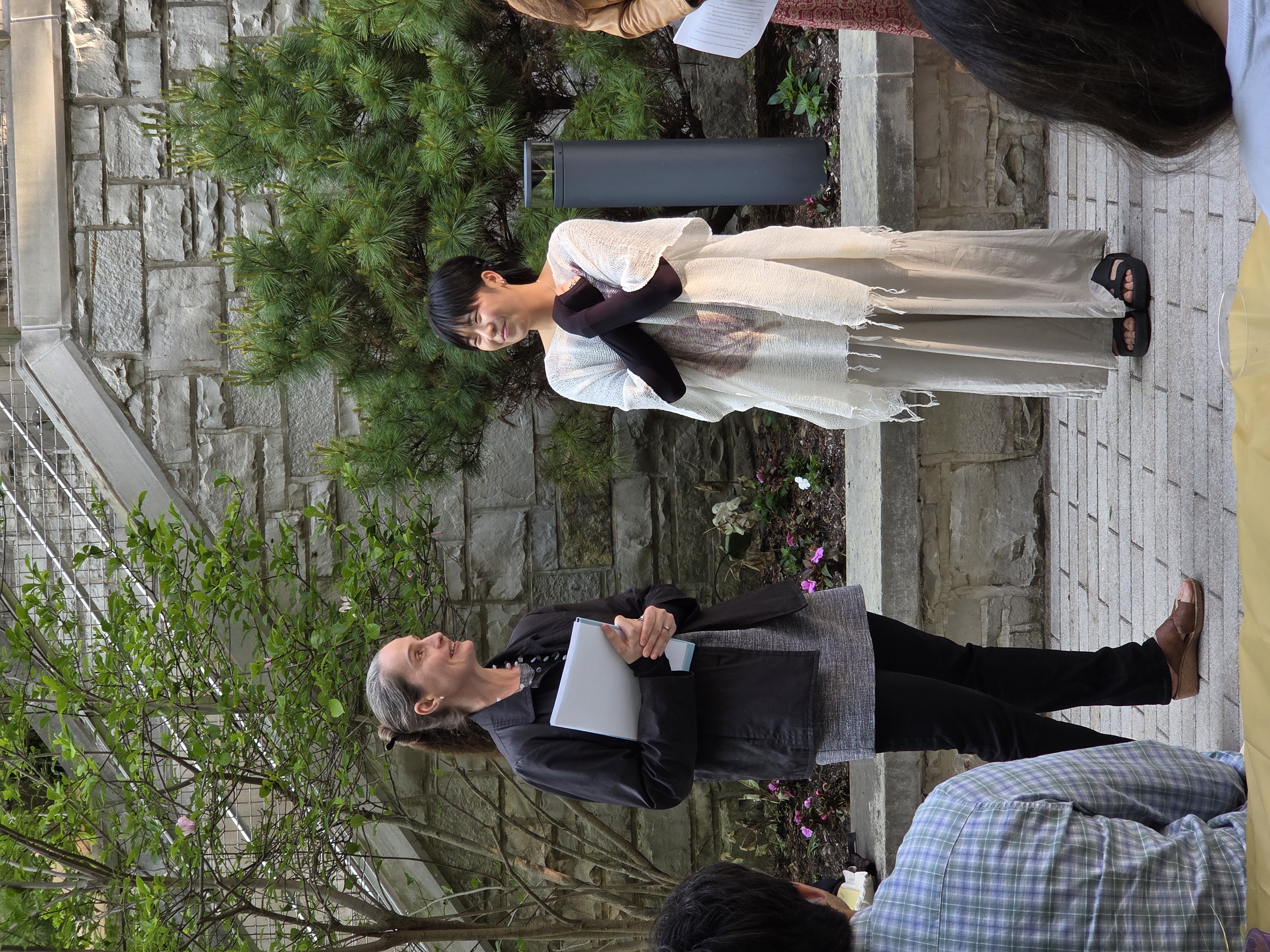
At 20, Audrey Zhou was handed a badge that opened every hospital door of UChicago Medicine – and told to introduce herself as the chaplain. She was new to chaplaincy, to prayers and to religion itself. Though it was ‘terrifying,’ she walked in and offered space anyway.
Zhou (’25) majored in religious studies, psychology and biological sciences on the pre-med track. She was awarded the inaugural Richard Kieckhefer Undergraduate Grant, which helped fund her summer chaplaincy work. She also received a Summer Undergraduate Research Grant, through which she conducted an autoethnography rooted in that experience.
“It was very intense and wonderful, abundant in all the things you think about and learn about the way the hospital works,” she says. Zhou’s intern group did rounds on the cardiac floor of UChicago Medicine through a program of Edward-Elmhurst Healthcare’s Clinical Pastoral Education program. Zhou completed 400 hours of training alongside a five-person cohort. She was the only undergraduate among graduate students. The program included 100 hours of small-group education and 300 hours of hands-on spiritual care with patients.
Zhou’s chaplaincy journey began with a conversation about Asian American Buddhism. During her sophomore summer, she conducted an independent study with Professor Sarah Jacoby, mapping Buddhist communities across Chicago. Jacoby encouraged her to reach out to writer and scholar Chenxing Han, whose work had sparked Zhou’s interest. After an hour-long conversation, Han connected her with someone exploring the intersection of religion and medicine, leading Zhou to a chaplaincy supervisor. Though it’s rare for undergraduates to apply, Zhou did — and was accepted for the summer.
Whenever a patient died or a trauma case arrived in the emergency room, a chaplain was paged. Zhou’s role was to comfort both patients and their families — but also to communicate. Since family members weren’t allowed in the trauma bay, she would often ask, “Do you want me to speak with your family in the waiting room? What can I tell them?”
One patient’s husband, shaken by his wife’s intubation, asked Zhou to return and offer prayer. Though new to prayer and unsure of herself, she Googled and memorized the “Our Father” and “Hail Mary.” When she returned, he looked visibly relieved. At the bedside, she stumbled through the prayers, drawing from her heart.
“And he’s standing next to me in tears, weeping, and I realized in that moment that it didn’t really matter what I said,” Zhou says. “What mattered was that I was there with him, to hold his experience.”
She says her interest in chaplaincy grew from her perspective as a pre-med student seeking to become a more compassionate doctor. Her senior thesis, “Do Not Forget the Spirit: Exploring Pastoral Pedagogies in Medical Education,” laid the foundation for her continued exploration of the intersection between medicine and spiritual care. This fall, she began her Master of Divinity program at Harvard Divinity School, where she plans to center her studies around that very integration.
She says chaplaincy is often called a “ministry of presence” — you show up, offer space and hold whatever patients entrust you with. For Zhou, that presence mattered more than knowing the right words. “Chaplaincy isn’t just teaching me how to pray. It’s teaching me how to show up for someone and make that space,” Zhou says.